Days 12, 13, and 14 (November 14, 15, 16)
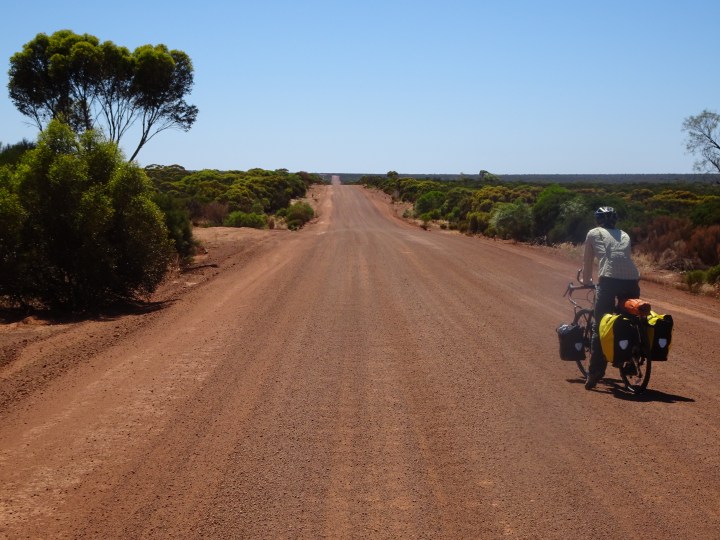
Wave Rock to Norseman – 310 km of nothingness
November 14 was the start of what we believed would be the most difficult part of the trip across Australia. Our route took us eastward 310 km from Wave Rock to the town of Norseman, nearly all of it on a remote dirt and gravel road with very little vehicular traffic. The defining characteristic of this segment was the near total absence of towns, gas stations, or other places to obtain water. The only thing between Wave Rock and Norseman was a nickel mining operation, at the 75 km mark, where we anticipated we might be able to refill our water containers. But more about the water situation in a bit.
The first day of the crossing, November 14, we got a fairly early 6:00 am start from Wave Rock. The information we had showed that the first 32 km of the road were paved, but we were pleasantly surprised to see that the pavement continued another 13 km, making 45 km of pavement, after which the dirt and gravel began. The riding wasn’t too difficult and the temperature, while a bit hot for this Alaskan, wasn’t intolerable. We rode until 5:15 pm, covering 108 km, when we came across a roadside picnic table at the boundary between Kondinin Shire and Dundas Shire (a shire is analogous to a county in the U.S.). The Moon was full that night and lit up the remote Australian landscape around us.
The wind picked up in the early morning of November 15, and by the time we were packed up and on the bikes, the wind had turned into a strong 20-25 km headwind, which very unfortunately for us, continued all day long. Coupled with the hotter temperatures (37 degrees C), the conditions radically decreased our speed. After knocking out the first 50 km, and not being able to refill our water bottles at a second mining operation (it was closed down), it got to the point where we would pedal 5 km, then stop for an extended break in what little shade we could find. The slow pace was due primarily to my difficulty dealing with the heat (hey, I’m from Alaska – gimme a break!). The heat and hot headwind reminded me of the hot blast of air you get when you open an oven door. To deal with it to some degree, I soaked my travel towel with some of my precious water and kept it in a Ziploc bag in my pannier. When we’d get to a rest break, I took the soaking wet towel out of the bag and let the breeze blow through it. The rapid evaporation cooled it quite well, which when then applied to the face and neck, provided some welcome cooling action and temporary relief from the heat.
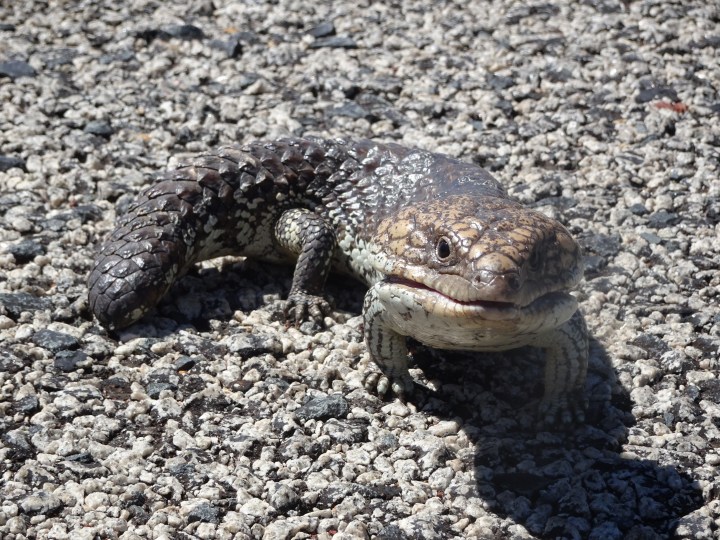
An Australian Bobtail lizard – a cute little fellow!
Such a vicious little guy!
Unlike me, Mattie seemed totally unfazed by the heat. She is, after all, a firefighter, so a little heat is nothing to her. She took the lead up front, while I did my best to keep up. I think the worst part of it for her was having to put up with my long rest breaks, knowing all the while that we could have already been at our destination for the day if I wasn’t slowing things down.
Despite the heat and the slow pace, we covered 87.5 km to Johnston Lake, making it there at 5:00 pm. I should also mention the flies. The flies here are epic. The second you stop moving, they are all over you. The only relief is our head nets, which although the flies still buzz around our heads, at least they’re not in our face.
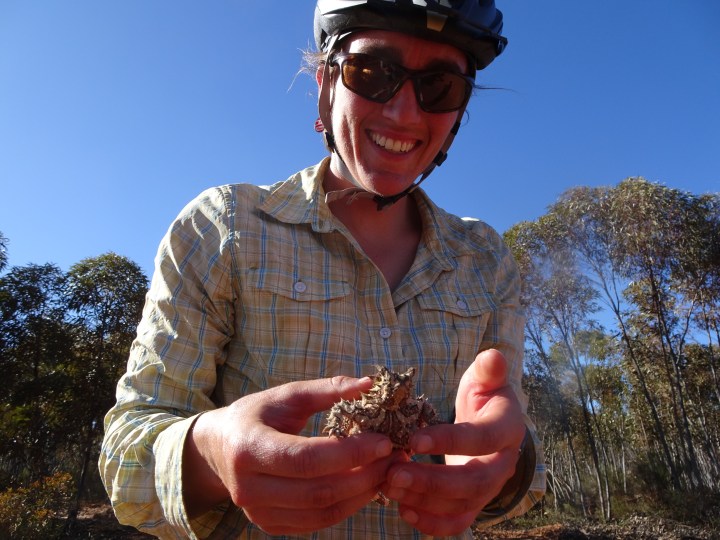
Mattie and her Thorny Dragon friend
The morning of November 16 dawned with increasing clouds and a wind from the west – all in our favor. We woke up at 4:30 am and were on the road at 5:15 am. The cooler temperature, 100% cloud cover, and a nice tailwind did wonders for our forward progress. We originally planned to do about 60 km, but when we reached that mark after only about 4 hours, we decided to take advantage of the situation and continue all the way into Norseman, which we pulled into at 12:15 pm, after putting a quick 108 km of road behind us.
I originally figured that the 310 km from Wave Rock to Norseman would take at the very least, four days, and possibly even five. We did it in 2 1/2 days. Pretty remarkable progress, I’d say!
Now, about the water situation. We knew that water opportunities would be very limited. Before we left Wave Rock, Mattie asked around Hyden and the campground about what we’d heard might be the possibility to get water at several mining operations along the way. She was able to get the name of a contact person at one of the mines, and phoned her. The woman at the mine assured us that we would indeed be able to get water there, and possibly even at the next mine further down the road. At mid-day on the first day (November 14), we pulled in to the mine and were welcomed and given a short tour of some of the operation. Best of all was, what seemed to us, the seemingly limitless supply of water. And they even had an ice-making machine, chock full of ice-cold ice! Wow, what a treat!
We took a nice long lunch break at the mine, chugged as much water as we could, refilled all of our bottles, and hit the road fully loaded. Mattie had about 11 liters of water, and I had about the same. We figured that would be enough to get us to the next mine further up the road the next day, so were feeling pretty confident in our water supply. The next morning (November 15) our bottles were down several liters, and when we passed an unexpected pond/puddle next to the road, we decided to put our three water filtration/purification systems to the test. Despite the water being quite muddy and gross looking, the filtered and purified water looked as good as regular tap water. Our system was first to filter, then chlorinate, and finally purify the water using a Steripen UV light purifier. I think the three stages – filtration, chlorination, and UV purification – worked very well (at least we didn’t get sick – yet!).
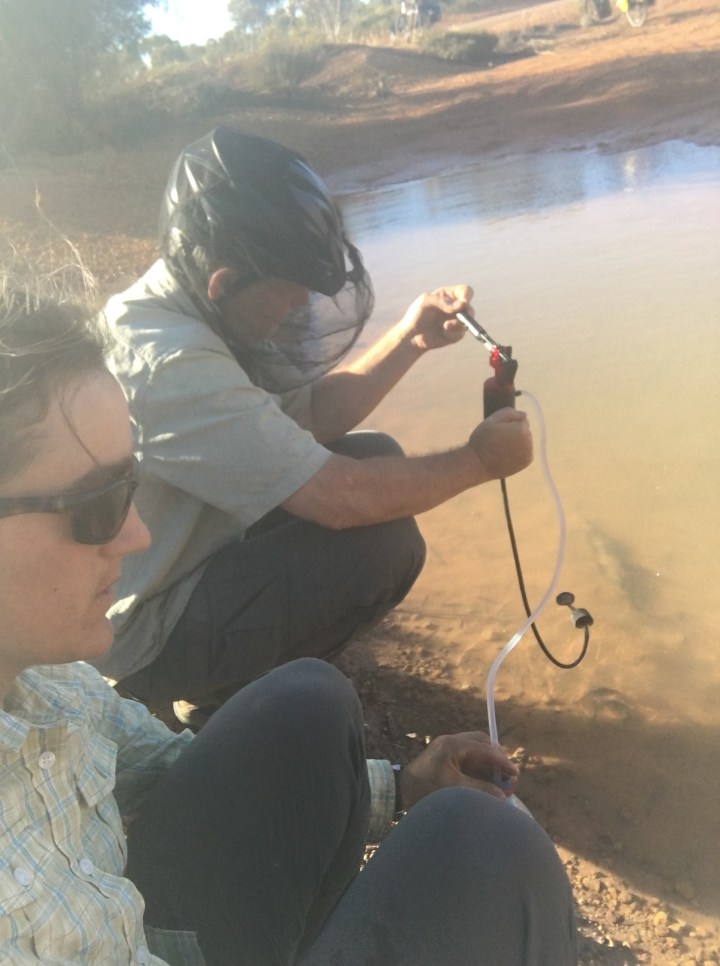
Impromptu roadside water supply
After filling our bottles at the puddle, we continued on down the road toward the second mine where we hoped to refill again. Unfortunately, the mine was closed with a locked gate across the access road. So there was no possibility to refill there, and by that point we had only about half of our water left, with 150 km still to go to Norseman. We figured that we just didn’t have enough water bottles/containers, so we picked up several 1.5 liter water bottles (with caps) that we found along the roadside, in the event that we would come across an opportunity to get more water. Later in the afternoon, luck was with us on three separate occasions when we came across friendly caravaners (RVers) who were kind enough to give us some water. Much thanks to those friendly Grey Nomads! With our bottles at full capacity on the morning of November 16, we easily made it into Norseman by mid-day on the 16th.
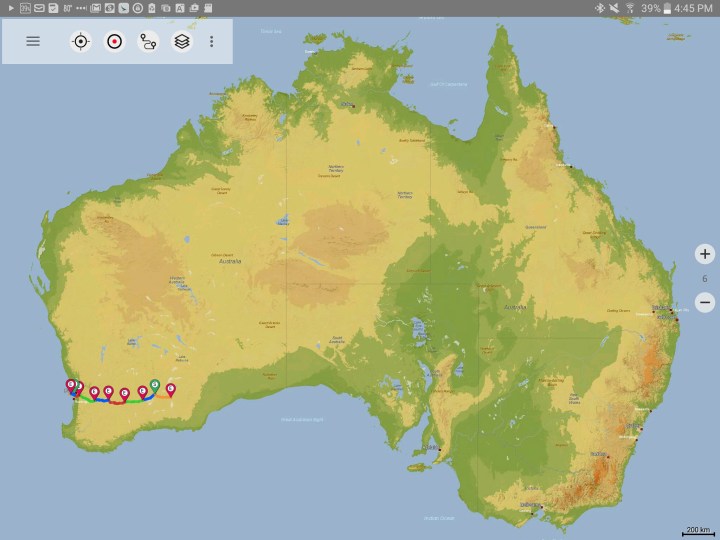
Perth to Norseman – 770 km down, thousands more to go
We’re now in Norseman taking a rest day at the Railway Hotel (a quaint little place that Mattie really likes). Tomorrow we’ll start the long 1,200 km trip across the Nullarbor Plain, so don’t be surprised if you don’t hear from us for a few days!
Posted by Scott
 Indian to Pacific
Hello Bike Adventurers!
Hannah wants to know: “Have you ever had to stop because there was a stubborn animal in the way? If yes, what animal was it?”
Amos asks: “What type of animals have you seen that are only native to Australia?”
LikeLike
Hello Hannah and Amos,
Thanks for the comments. (For the other followers of this blog, these questions are posted by my sister’s seventh grade class from Lewiston, Idaho.) As for stubborn animals on the road, Hannah, the only animal that “stood its ground” was the 10″ long bobtail lizard we biked past. This harmless lizard tried to be ferocious, but at 10″ and slow moving, Scott and I were rolling with laughter!
And Amos, Scott and I got our fill of quokkas, a small marsupial endemic (native only to a small area) to south western Australia. We have seen lots of birds, plants and lizards that are only found here, but most other animals are nocturnal (awake at night) thus we do not see them as that is when Scott and I are sleeping. We have seen lots of emu and kangaroo tracks, but nothing alive yet! Hopefully before the trip is over we get to see these large animals.
-Mattie
LikeLike
Autumn wonders: “How do you withstand the heat all day?”
LikeLike
The first thing we do is get up very early in the morning (4:30 or 5:00 am) when it is still cool. We can get about 3 or 4 hours of riding done before it really starts to get hot in the afternoon. When it does start getting hot, I get a towel wet, and then let the wind blow through it a bit. The evaporation cools the towel and then I put the cool towel on my face and neck. It helps a lot, but it’s only temporary relief. I then put the wet towel in a plastic ziplock bag and use it the next time we take a break. And when we take a break, we always find a shady spot under the roadside trees.
LikeLike
Hi there, this is Jennifer Alldredge and I teach with your sister Soona. We have been reading your blog and my students have some questions!
How much was the water filtration system? Why did you choose Australia to bike across? What is the scariest animal you have encountered? What is your final destination and when do you expect to get there?
LikeLike
Thanks for the questions Jennifer. We carried multiple water purification systems for the beginning of the bike trip as water resources were very limited and we expected very nasty water for filtration (which we did end up filtering and drinking!). The carbon water filter and the UV SteriPen each cost about $100 USD. We also carry chlorine drops which are very affortable.
Scott chose to bike across Australia as it is a common bike tour, he loves the Australian accents and to bike across an entire continent is a huge (and managable) goal!
So far, the most fearful looking creatures we have run across are the really large and very common spiders. We also saw a dugite, a venomous snake. At the time we had no idea this snake was one of the most venomous snakes in Western Australia!
Our final destination is Sydney. Our flights out of Sydney are on January 6th so hopefully we make it there before then!
-Mattie
LikeLike